Not All AI Notes Are Created Equal: A Buyer’s Checklist for Voice AI Documentation
November 18, 2026
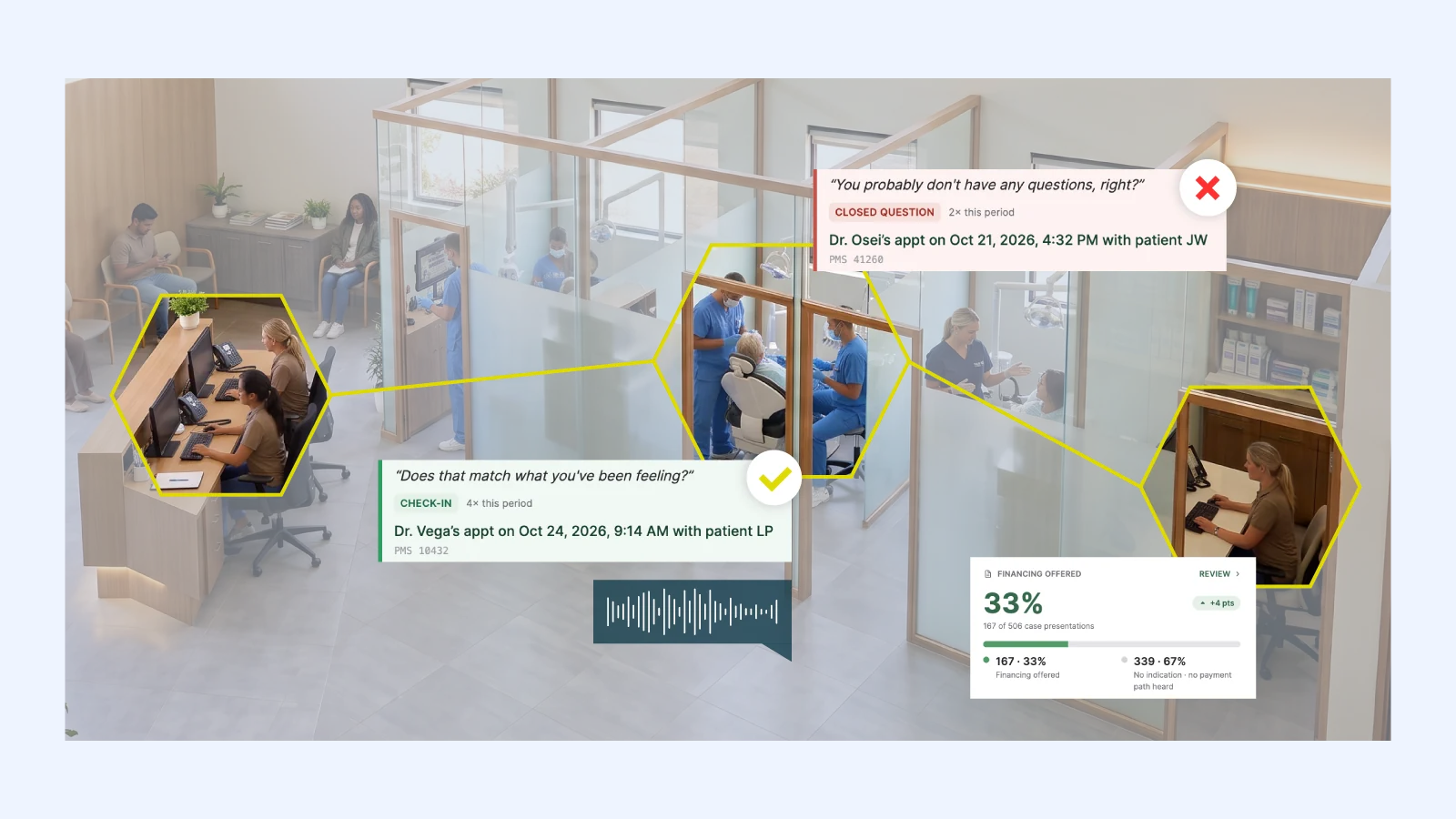
Shopping for dental voice AI? Here's what to look for beyond a polished demo.
Every voice tool says it’s accurate. Here’s what actually determines whether you walk out of the operatory with complete clinical documentation— or if you’re finishing it at 9 p.m.
AI is changing how dental practices create clinical notes, helping providers spend less time documenting visits and more time focused on patients. According to the ADA Health Policy Institute, 43% of U.S. dentists already use AI for at least one practice task, with charting and note-taking ranking as the No. 1 planned use. And with 82% of dentists reporting that they feel overworked (JADA, 2026), it's not hard to understand why dental clinicians are turning to automated clinical documentation.
But not all dental voice AI solutions are created equal.
Some tools simply transcribe conversations. Others understand dental terminology, distinguish between speakers, generate complete clinical notes, and integrate directly into your practice management software.
And while every demo might look impressive, the real differences become clear once the software is part of your daily workflow and put to the test in a busy, noisy dental office.
Before choosing an AI note taking solution for your dental practice, here are seven questions worth asking.
The Dental Voice Notes Buying Checklist
1. Does it generate complete, accurate dental documentation without being bloated?
This is arguably the most important question. An accurate transcript of a messy conversation is still a messy note. And longer isn't necessarily better: capturing every word spoken in the operatory doesn't mean creating documentation anyone wants to read.
A complete procedure note should capture the details your billing team, an auditor, and the next provider need to understand what happened and why. Depending on the appointment, that includes:
- Reason for visit and diagnosis
- Relevant medical history and vitals
- Procedure steps and materials
- Anesthetic details
- Patient response and post-op instructions
- Follow-up and treatment plan
Getting these details right has implications beyond the chart itself: better support for claims, more defensible documentation, and smoother handoffs between providers.
That's the standard Videa Voice Notes is designed to meet. In our evaluations, Videa Voice Notes captured exam details, clinical findings, and treatment plans more consistently than the hand-typed notes they replaced — while keeping documentation concise and requiring minimal edits before signing. And the vast majority of providers using Videa Voice Notes say it improves their note quality.
Ask vendors: Show me a real note from a crown delivery or an SRP appointment. Does it capture the relevant clinical details? Is the note structured and easy to read? How much editing does a provider typically need before signing?
2. Was the AI documentation software built specifically for dentistry?
General-purpose AI scribes may understand medical conversations, but dentistry has its own terminology, clinical workflows, and documentation requirements. Tooth numbering, surfaces, restorative procedures, and periodontal charting require specialized knowledge. Without that foundation, even a seemingly accurate note can miss important clinical context.
Videa Voice is built on more than 1 billion dental data points from over 90,000 clinicians. It's dental from the ground up, with an understanding of the terminology and workflows that make dental documentation different.
Ask vendors: Was the solution developed using dental-specific data? Does it understand tooth numbering, surfaces, and dental terminology? Show me examples from both restorative and hygiene visits.
3. Is it truly ambient AI— or just dental dictation software?
Some "AI voice notes" are really just dictation: providers talk at the computer after the appointment, sometimes against a recording timer. That's still documenting the visit twice.
True ambient documentation captures the natural conversation happening during the appointment, allowing providers to focus on the patient instead of narrating every step for the software.
Videa Voice offers both Smart Ambient, which listens to the natural conversation, and Quick Dictation for when providers prefer to dictate. The goal is flexibility without sacrificing the simplicity of a hands-free workflow.
Ask vendors: Can I have a normal conversation with my patient without dictating? Does the system require specific commands or prompts? Are there recording time limits?
4. Can your dental AI scribe identify who’s talking?
A dental appointment isn't a dictation. It's a conversation between a provider, a patient, an assistant or hygienist — sometimes a parent, too. And often, it’s in the middle of a loud, busy dental office with other conversations within earshot. Many AI scribes capture this as one continuous stream of words instead of multiple individuals.
That distinction matters. "My tooth's been sensitive to cold for two weeks" is the patient's report. "Let's watch #19 and recheck in six months" is the provider's clinical plan. A side comment to an assistant isn't necessarily part of the patient discussion. When a tool can't distinguish between those speakers, important context gets blurred, and the provider is left to untangle and manually edit the note after it is written.
Videa Voice Notes identifies speaker roles in the room, helping distinguish what the patient described, what the provider found and recommended, and what the team discussed.
Ask vendors: Does your tool distinguish between the provider, patient, and staff? Can it handle three or more people in the room using one shared microphone?
5. Does it work with your existing note templates?
Every dental practice has its own approach to documentation. Providers may have preferred note formats, specific clinical details they need to capture, and templates built around the way their team works. An AI note tool should support those workflows, not force providers to change how they chart. If generated notes don't fit existing templates or require significant editing to get them into the right format, the time saved by AI can quickly disappear.
Videa Voice works with existing note templates, helping practices maintain their preferred documentation workflows while generating chart-ready notes.
Ask vendors: Can the solution work with our existing note templates? Can templates be customized to reflect different provider or practice preferences? Does the generated note follow the structure our team already uses, or will providers need to spend time reformatting it?
6. Does it support hands-free perio charting?
Periodontal charting is one of the most repetitive parts of a hygiene appointment — and one of the areas where accuracy matters most. One incorrect reading can mean stopping to make corrections or going back to manual entry. It is also one of the most time consuming parts of an appointment, often requiring two providers.
A voice solution that only generates narrative notes leaves another major documentation workflow untouched.
Videa Voice includes Voice Perio, allowing hygienists to call out periodontal readings hands-free while the chart populates without having to call in another provider to help.
Ask vendors: Is periodontal charting included, or is it a separate product? Can hygienists call out readings hands-free? What happens if a reading needs to be corrected or the workflow is interrupted?
7. Does it integrate with your PMS?
Even the most accurate AI documentation tool won't deliver much value if it's difficult to access or adds steps to the appointment workflow. Providers shouldn't have to switch between applications, copy and paste notes, or navigate a complicated setup just to document an encounter. The right solution should fit into the systems your team already uses and feel intuitive from the start.
Integration and adoption go hand in hand. A solution that works seamlessly with your PMS and is easy for providers to learn is much more likely to become part of the team's everyday workflow.
Videa Voice integrates with more than 90% of PMS and imaging systems, including Dentrix, Dentrix Ascend, OpenDental, Eaglesoft, and more. With Videa Companion, providers can start and end a recording with one click, right where they already work, without switching tabs. Practices have become proficient with Videa Voice in as little as one day.
Ask vendors: Does documentation post directly to our PMS, or does the team have to copy it over? Which PMS and imaging systems does the solution integrate with? How many steps does it take to start and stop a recording? How long does onboarding typically take, and what support is available to help providers adopt the tool?
Less admin, better care
The right voice solution should feel like a great team member: it listens, understands dentistry, knows who's talking, and delivers a complete note before you leave the operatory.
You stay focused on your patient. Your clinical judgment stays yours. And your team spends less time chasing documentation and more time focused on care.
That's the standard Videa Voice is built to meet. With speaker roles now live, we're taking another step toward more intelligent dental documentation — one that captures not just what's said in the operatory, but who's saying it and what it means.
Ready to see what better dental voice documentation looks like?
See what better dental documentation looks like
Related blog posts

Apr 14, 2025
Videa featured in Heartland Dental’s 2024 Mid-Year report on growth and dental AI innovation
Discover how Heartland Dental is leveraging dental AI from Videa to improve diagnostic accuracy, drive preventive care, and support 2,800+ doctors across 1,750+ offices nationwide.

Jan 29, 2024
Beyond words: Videa's AI and the future of dental patient education
Explore the transformative impact of artificial intelligence (AI), particularly through Videa, on oral health literacy. Addressing challenges such as language barriers, Videa's AI provides personalized visual representations, overcoming the limitations of traditional methods and revolutionizing patient education by increasing oral health literacy and fostering collaborative, informed approaches to dental care.

Nov 12, 2024
Harnessing AI for care standardization: the future of dental practice management
Dental Service Organizations (DSOs) and large group practices face the challenge of delivering consistent, high-quality care across numerous locations and providers. AI-driven care standardization offers a solution by aligning treatment approaches, reducing diagnostic variability, and enhancing early detection in critical areas like caries detection. Recent studies demonstrate how AI improves diagnostic accuracy, supports evidence-based care, and strengthens quality assurance, empowering DSOs to ensure uniform standards and improve patient outcomes. Videa’s AI solutions are at the forefront of this transformation, enabling dental organizations to deliver reliable, efficient care on a large scale.
Get started today
Schedule time with our team to learn more.